Artificial intelligence is changing how people create, order, and share caricature art. Tasks that once required hours of drawing can now begin with a photograph, a written description, or a few creative instructions.
AI-powered tools can generate cartoon-style portraits, suggest exaggerated facial features, test different art styles, and help artists develop ideas more quickly. These capabilities have made caricature-style images easier for beginners, businesses, and everyday users to explore.
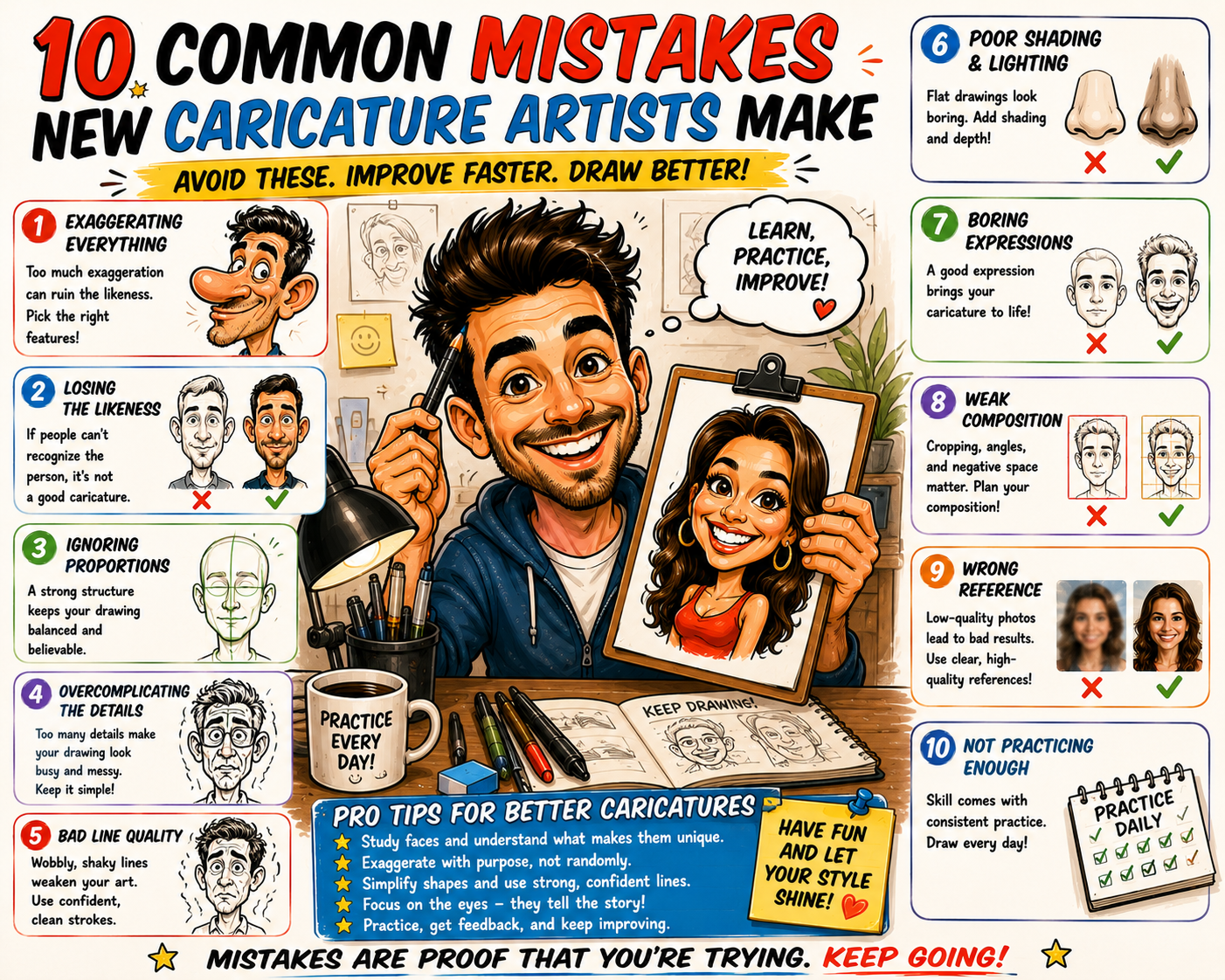
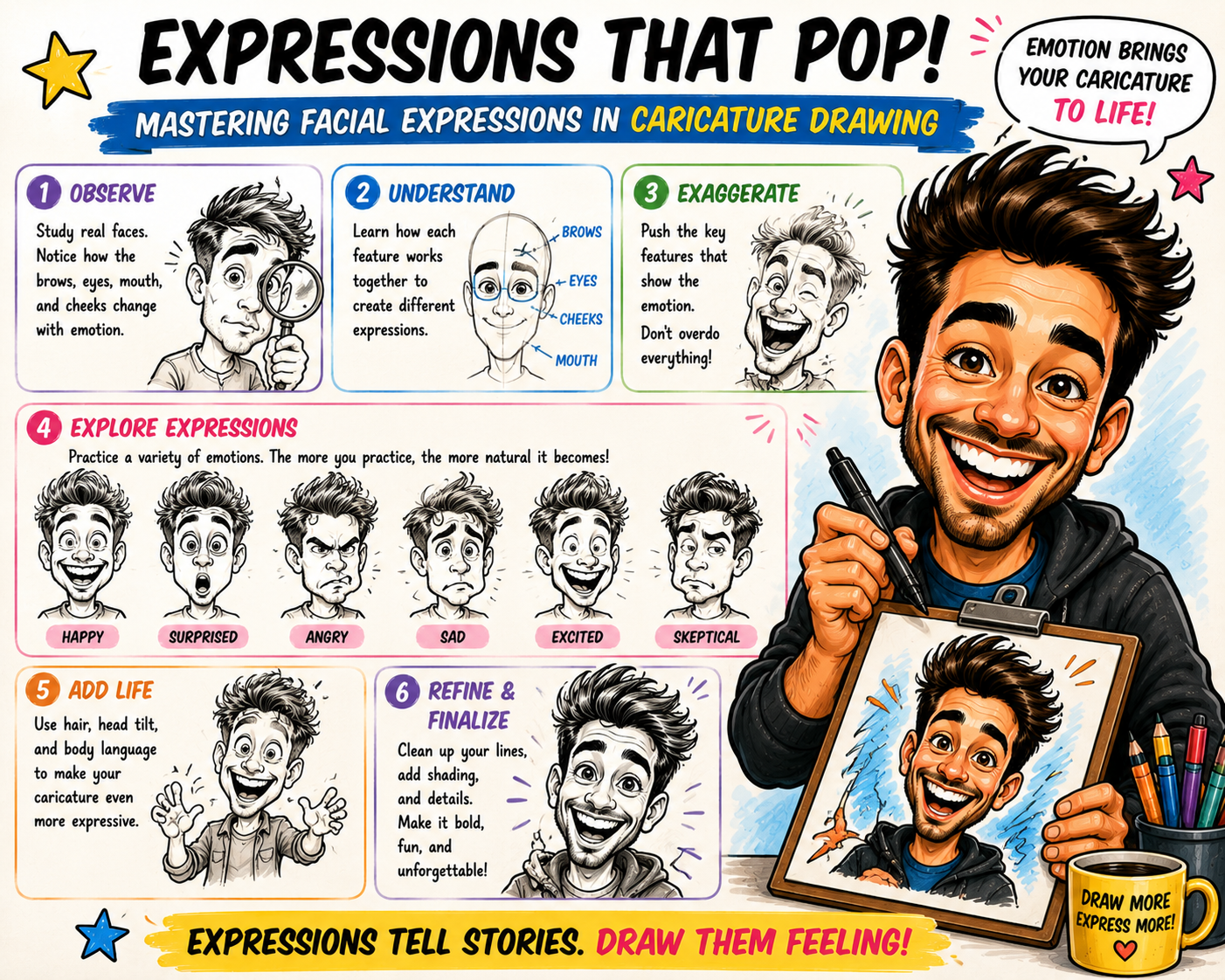
However, faster technology does not eliminate the importance of artistic skill. Strong caricatures still depend on likeness, observation, personality, humor, and intentional exaggeration.
What Is an AI Caricature?
An AI caricature is a digitally generated or AI-assisted portrait that exaggerates selected facial features while attempting to preserve the subject’s identity.
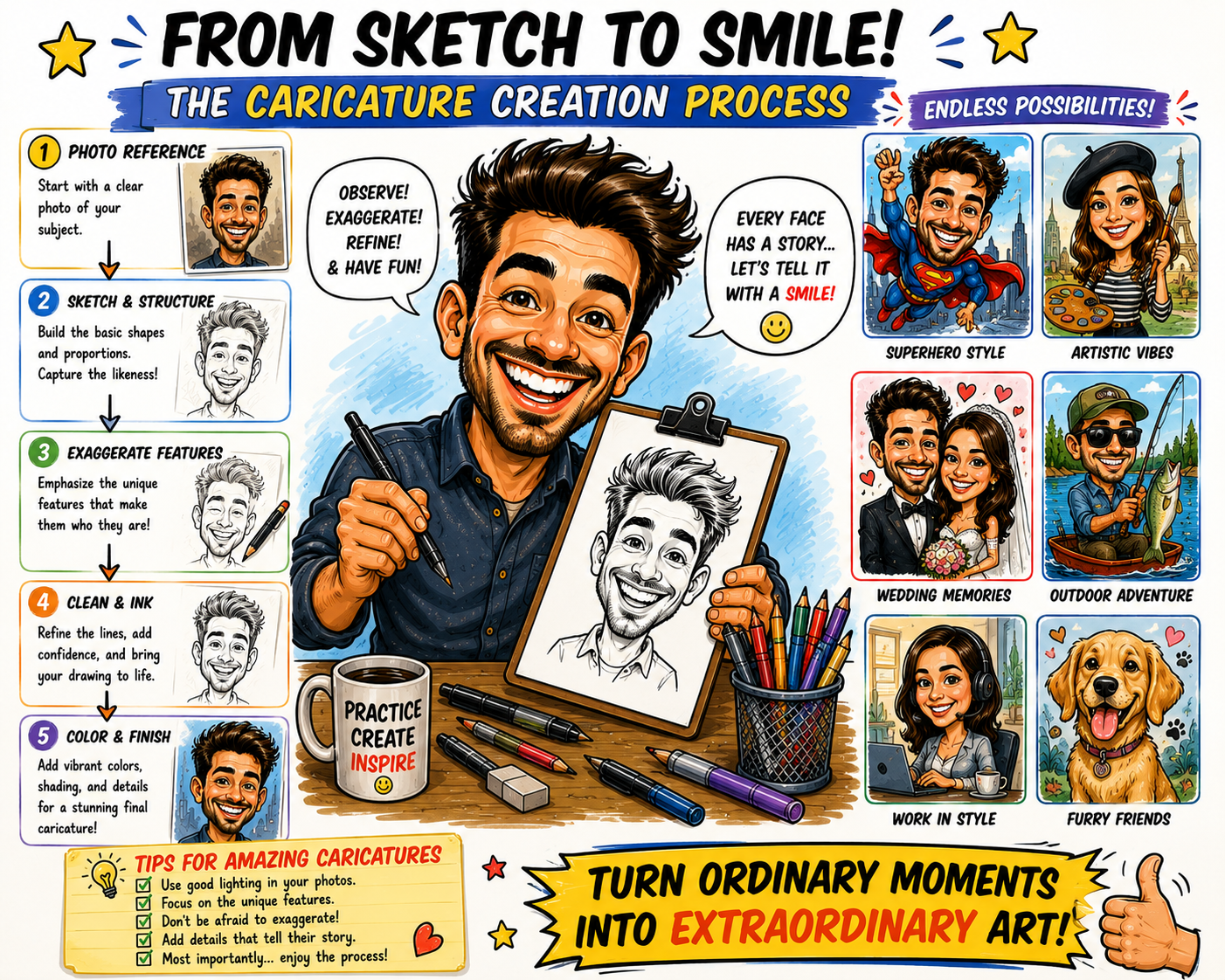
The artwork may be created from a photograph, written description, sketch, or combination of visual references. Depending on the tool and instructions, the result may look like a simple cartoon, polished digital painting, comic-book character, humorous portrait, or highly exaggerated caricature.
How AI Caricature Tools Work
AI image systems analyze patterns in faces, illustrations, colors, expressions, and artistic styles. They use those patterns to create a new image based on the user’s instructions.
A user may request a portrait with a larger smile, fuller cheeks, a smaller body, bright clothing, and a humorous background. The AI then attempts to combine those details into one image.
Some tools focus on automatic photo transformation, while others allow more detailed written instructions and repeated revisions.
Ways AI Is Changing Caricature Art
1. Faster Concept Development
Artists can use AI to explore several ideas before beginning a finished drawing. Different poses, costumes, expressions, backgrounds, and compositions can be tested quickly.
This can reduce the time spent staring at a blank canvas and help the artist identify a stronger direction.
2. Quick Photo-to-Caricature Transformations
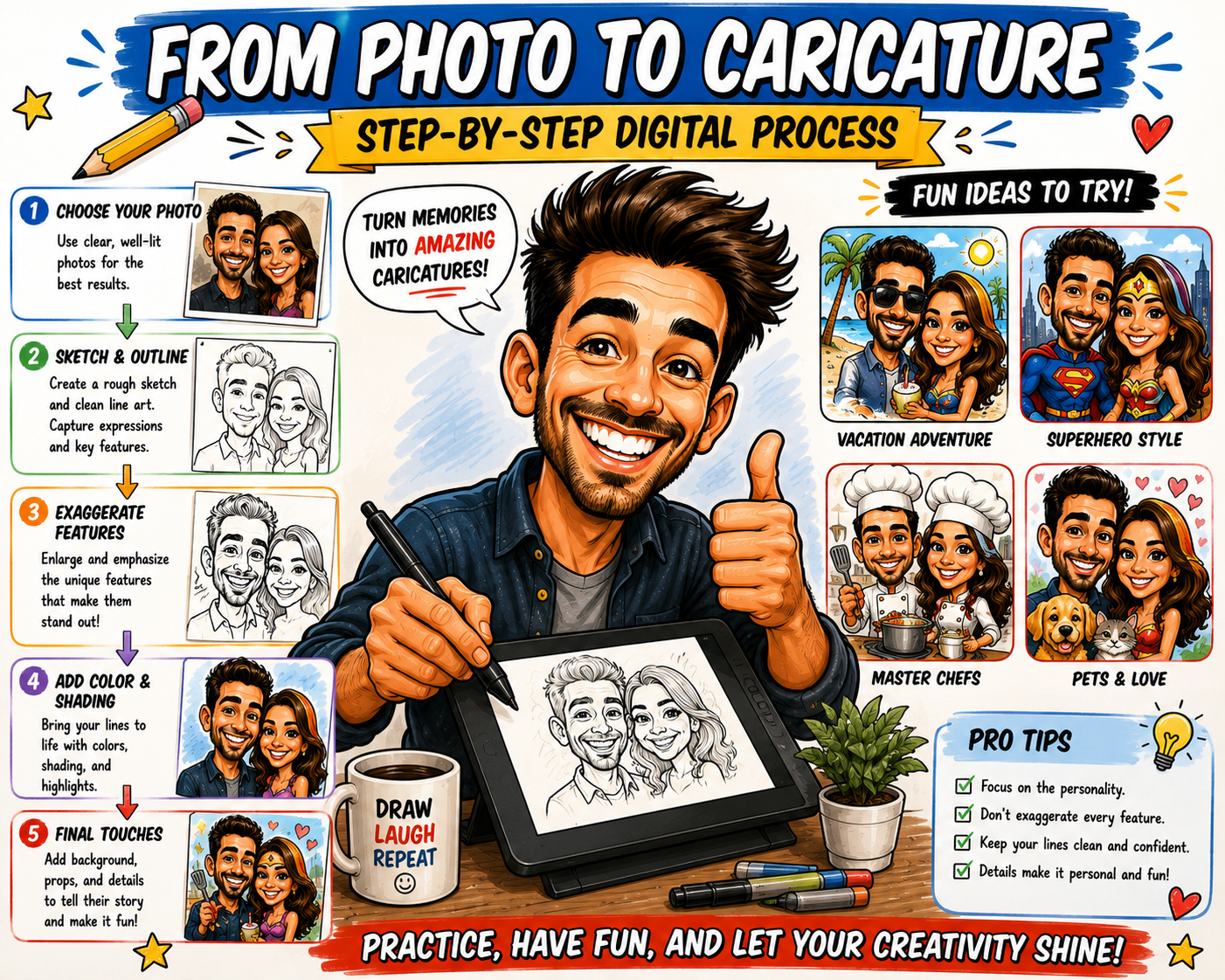
AI can turn a photograph into a cartoon-style image within a short period of time. This makes caricature-like portraits accessible to people who may not know how to draw.
These transformations are popular for social media profiles, party invitations, humorous gifts, digital greetings, and personal entertainment.
3. More Style Choices
Users can experiment with bold outlines, painted textures, simplified cartoons, comic-inspired portraits, realistic digital art, or colorful poster designs.
Changing the instructions can produce multiple versions of the same basic idea.
4. Easier Background Creation
Detailed backgrounds can take longer to draw than the caricature itself. AI can help create ideas for beaches, offices, wedding venues, gardens, city scenes, sports fields, and fantasy settings.
An artist can then simplify, repaint, or redesign the background to match the portrait.
5. Faster Color Exploration
AI-assisted workflows can help artists test clothing colors, lighting, background palettes, and decorative effects.
Seeing several color directions early can make it easier to choose the strongest final design.
6. New Personalized Gift Options
Customers can request caricatures showing couples, families, pets, coworkers, or friends in imaginative situations.
A person can be shown as a superhero, musician, gardener, traveler, athlete, chef, or fantasy character without arranging a special photo session.
7. Greater Access for Beginners
AI gives beginners a way to explore caricature ideas before they have developed advanced drawing skills.
A beginner can study how different exaggerations change a face, compare artistic styles, and use generated images as inspiration for drawing practice.
8. New Business Opportunities
Artists and designers can combine AI-assisted concepts with original drawing, editing, personalization, and customer service.
Possible services include personalized portraits, event graphics, greeting cards, invitations, business mascots, social media artwork, and merchandise designs.
AI Caricature vs. Hand-Drawn Caricature
| Feature | AI Caricature | Hand-Drawn Caricature |
|---|---|---|
| Creation speed | Can produce initial results quickly | Usually requires more drawing time |
| Creative control | Depends on instructions and available editing tools | The artist controls every line and exaggeration |
| Likeness | May vary between generations | Can be carefully adjusted by observation |
| Personal style | May imitate a broad visual category | Reflects the artist’s individual drawing style |
| Revisions | New versions can be generated quickly | Changes are made intentionally by the artist |
| Live entertainment | Usually created through a device or application | Guests can watch the artist draw in person |
| Emotional connection | Often based on automated interpretation | Can reflect direct interaction and personal observation |
What AI Does Well
AI can be especially useful for generating broad ideas and visual variations.
It may help with:
- Testing several costume ideas
- Exploring different backgrounds
- Creating quick composition drafts
- Trying alternative color combinations
- Generating humorous visual concepts
- Producing reference images for poses
- Creating decorative elements
- Developing early customer mockups
These capabilities can speed up preparation while allowing the artist to focus more attention on likeness and refinement.
Where AI Caricatures Can Struggle
Consistent Facial Likeness
An AI-generated portrait may capture the general appearance of a person but change the eyes, nose, mouth, age, hairstyle, or expression.
Small changes can make a caricature resemble someone else, especially when several people appear in one image.
Choosing the Right Feature to Exaggerate
An automated system may enlarge the most obvious feature without understanding which quality is most important to the person’s identity.
A skilled artist may decide that a particular smile, eyebrow angle, head shape, or posture matters more than the size of the nose.
Hands and Small Details
Complicated hands, jewelry, clothing patterns, text, and background objects may require correction or redrawing.
Group Portrait Consistency
In family, wedding, or corporate group portraits, it can be difficult to keep every person recognizable and proportioned correctly.
Understanding Personal Humor
AI does not automatically understand family jokes, workplace stories, personal memories, or the emotional meaning of a particular object.
These details must be carefully explained and reviewed by a person.
Will AI Replace Caricature Artists?
AI will likely continue to automate simple cartoon transformations and basic portrait effects. However, caricature art involves more than changing facial proportions.
Human artists observe personality, body language, natural expression, humor, and emotional context. They can speak with customers, understand the meaning behind a gift, adjust the level of exaggeration, and make sensitive creative decisions.
Live caricature artists also provide entertainment and personal interaction that an automatic image tool cannot fully reproduce.
How Caricature Artists Can Use AI Responsibly
Artists can use AI as a creative assistant while maintaining control over the finished work.
A responsible workflow may include:
- Study the customer’s reference photographs.
- Write down the most distinctive facial features.
- Use AI to explore poses, costumes, or background ideas.
- Create an original sketch based on personal observation.
- Correct the likeness manually.
- Refine the line work, color, and expression.
- Review all details before delivery.
- Be clear with customers about how the artwork was created.
AI as a Brainstorming Tool
One of the most useful roles for AI is brainstorming. A customer may know that they want a retirement caricature but have no clear idea for the scene.
AI can help explore possibilities such as a beach vacation, golf course, garden, fishing boat, camper, or humorous escape from the office.
The artist can then select the best concept and create a more personal, organized composition.
Using AI for Caricature Drawing Practice
Beginning artists can use AI-generated concepts as practice references, but they should continue developing traditional observation and drawing skills.
Useful practice exercises include:
- Compare an AI portrait with the original photograph
- Identify where the likeness became weaker
- Redraw the head shape manually
- Correct the spacing between facial features
- Create three different exaggerations of the same face
- Simplify a detailed AI image into clean line art
- Design a new pose instead of copying the generated one
These exercises encourage the artist to make independent decisions instead of accepting every automated result.
How AI Is Affecting Personalized Caricature Gifts
Personalized caricature gifts can now be planned and previewed more quickly. Customers may be able to see several concepts before choosing the final direction.
A wedding couple could compare a romantic beach scene, formal ballroom portrait, or humorous getaway image. A family could choose between a superhero theme, vacation setting, or classic group portrait.
The final artwork may still require manual editing to improve facial likeness, clothing, text, and personal details.
AI Caricatures for Businesses
Businesses may use AI-assisted caricature artwork for employee profiles, advertisements, social media graphics, presentations, event signs, and promotional gifts.
A company could create matching illustrated portraits for team members or use a humorous character to explain a service.
Businesses should make sure that the final artwork is accurate, professional, and suitable for its intended use.
AI and Live Caricature Events
Live event caricature is beginning to include more digital tools. Artists may draw on tablets, project the process onto a screen, print portraits on location, or add themed backgrounds.
AI could assist with background preparation, decorative effects, or rapid concept development. However, the artist’s ability to interact with guests and capture a recognizable expression remains central to the experience.
The combination of technology and live drawing may create new forms of event entertainment.
Questions Customers Should Ask
Before ordering an AI-assisted caricature, customers should understand what they will receive.
- Will the artwork be manually edited?
- How closely will it resemble the reference photo?
- Are revisions included?
- Can clothing and background details be changed?
- What file size and format will be delivered?
- Can the artwork be printed?
- Is commercial use included?
- How will submitted photographs be handled?
Privacy and Reference Photos
Caricature creation often requires personal photographs. Customers should review how a service handles uploaded images before submitting them.
Artists should obtain permission before posting customer photos or finished portraits publicly. A photograph provided for a private commission should not automatically become advertising material.
Extra care may be appropriate when working with photographs of children, private family events, or confidential business projects.
Questions About Ownership and Usage
Customers and artists should discuss how the final artwork may be used.
Personal use may include printing a portrait, sharing it with family, or using it as a profile image. Commercial use may include advertising, product packaging, merchandise, company branding, or resale.
Usage terms should be clearly stated before the project begins, especially when the caricature will support a business or product.
How to Improve an AI-Generated Caricature
An AI result can become stronger through careful manual correction.
- Compare the portrait with the original photograph.
- Correct the overall head shape.
- Adjust the eyes, nose, mouth, and chin.
- Restore the person’s natural expression.
- Fix the hairstyle and hairline.
- Clean up hands, clothing, and accessories.
- Simplify distracting background details.
- Correct text and decorative elements.
- Apply consistent lighting and color.
- Review the image at the final print size.
What Skills Will Future Caricature Artists Need?
Artists will continue to benefit from traditional drawing skills while also learning how to direct and edit digital tools.
Important skills may include:
- Facial observation
- Portrait likeness
- Purposeful exaggeration
- Digital painting and editing
- Clear written instructions
- Composition and visual storytelling
- Color and lighting
- Customer communication
- File preparation for print and online use
- Responsible handling of reference images
The Future of AI Caricature Art
Future caricature tools may offer more accurate facial consistency, faster revisions, better group portraits, improved animation, and greater control over individual features.
Customers may be able to preview different themes, poses, and products before ordering. Artists may spend less time on repetitive preparation and more time improving likeness, personality, and storytelling.
The most memorable caricatures will likely continue to combine efficient technology with human creativity.
Frequently Asked Questions
Can AI create a caricature from a photograph?
Yes. AI tools can transform a photograph into a cartoon-style or exaggerated portrait. Results may vary depending on the quality of the photo, instructions, and editing.
Will AI replace professional caricature artists?
AI may automate simple transformations, but professional artists provide intentional exaggeration, personal interpretation, reliable likeness, customer communication, and live entertainment.
How can artists use AI without losing originality?
Artists can use AI for brainstorming and early concepts, then redraw, edit, personalize, and refine the final artwork using their own judgment and style.
Are AI caricatures suitable for gifts?
Yes, especially when the result is carefully reviewed and personalized with accurate faces, meaningful clothing, hobbies, pets, text, and backgrounds.
Why does an AI caricature sometimes not resemble the person?
The system may change important facial spacing, expression, age, hairstyle, or head shape. Manual adjustments can improve recognition.
Can AI caricature artwork be printed?
It can be printed when the image has sufficient resolution and the customer has the appropriate usage rights. Confirm the intended print size before finalizing the artwork.
Should customers submit private photographs to AI services?
Customers should review the service’s privacy terms and understand how uploaded images may be stored, processed, or used before submitting personal photographs.
Final Thoughts
AI is making caricature-style artwork faster, more accessible, and easier to customize. It can help generate ideas, transform photographs, develop backgrounds, test colors, and explore imaginative scenes.
At the same time, successful caricature art still requires thoughtful decisions about likeness, expression, personality, humor, and exaggeration. Automated results often benefit from the eye and judgment of a skilled artist.
The future of caricature art is likely to combine artificial intelligence with human creativity. Artists who learn to use new tools while continuing to strengthen their drawing and observation skills will be well prepared for this changing creative world.