
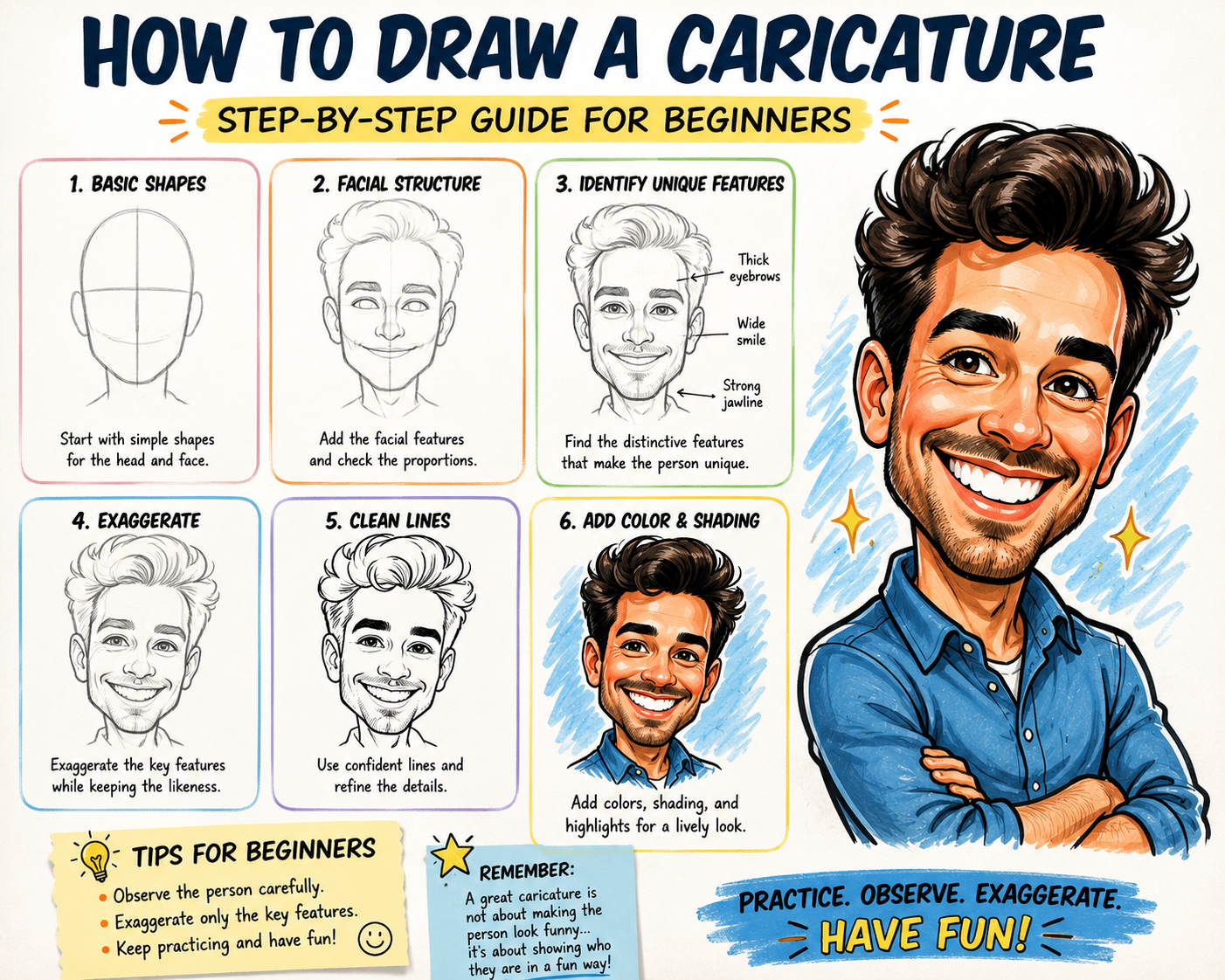
Caricatures and cartoons are both creative art forms that can be funny, expressive, and highly entertaining. Because they often use exaggerated features and simplified shapes, many people assume they are the same thing.
However, caricature art and cartoon art have different purposes. A caricature usually exaggerates the recognizable features of a real person, while a cartoon may depict an original character, an animal, an object, or an entire story.
Understanding the difference between a caricature and a cartoon can help artists choose the right style for portraits, gifts, comics, illustrations, advertisements, and entertainment projects.
What Is a Caricature?
A caricature is an exaggerated portrait of a real person. The artist studies the subject’s face and emphasizes the features that make that person unique.
For example, a caricature artist may enlarge a person’s smile, lengthen the chin, widen the eyes, or make the hairstyle more dramatic. Even though the proportions are changed, the person should still be recognizable.
Caricatures are often humorous, but they can also be flattering, elegant, dramatic, or affectionate. They are commonly created from photographs or drawn live at special events.
What Is a Cartoon?
A cartoon is a simplified or stylized illustration that may represent a person, animal, object, imaginary creature, or fictional character.
Unlike a caricature, a cartoon does not need to resemble a real person. Cartoon artists can invent characters entirely from their imagination and place them in humorous, educational, adventurous, or emotional situations.
Cartoons are commonly found in comic strips, animated videos, children’s books, advertising, greeting cards, social media posts, and television programs.
The Main Difference Between a Caricature and a Cartoon
A caricature depends heavily on likeness. If viewers cannot recognize the person, the caricature may not be successful. A cartoon, on the other hand, can be completely fictional and does not need to match a real-life subject.
Caricature vs. Cartoon Comparison
| Feature | Caricature | Cartoon |
|---|---|---|
| Main subject | Usually a real person | Real or imaginary characters, animals, and objects |
| Main purpose | To exaggerate recognizable features | To entertain, explain, tell stories, or communicate ideas |
| Importance of likeness | Very important | Optional |
| Common style | Exaggerated portrait | Simplified or imaginative illustration |
| Common uses | Gifts, events, portraits, satire, and commissions | Comics, animation, advertising, books, and entertainment |
| Humor | Often based on a person’s appearance or personality | May come from dialogue, action, characters, or situations |
How Caricature Artists Use Exaggeration
Exaggeration is one of the most important tools in caricature art. The artist identifies the facial features that are most distinctive and changes their size, shape, or position.
A person with large eyes may be drawn with even larger eyes. Someone with a broad smile may be shown with a dramatic grin. A tall hairstyle may become much taller in the finished portrait.
The challenge is to exaggerate the subject without losing the likeness. The finished image should look humorous or stylized while still clearly representing the person.
How Cartoon Artists Use Simplification
Cartoon artists often simplify forms so characters are easy to recognize and reproduce. A complicated face may be reduced to a few clean lines, basic shapes, and expressive features.
Cartoon characters may have oversized eyes, tiny bodies, flexible limbs, or unusual proportions. These choices are not always based on a real person. Instead, they are designed to communicate personality, emotion, or action quickly.
Simplification is especially useful in comics and animation because artists may need to draw the same character many times.
Can a Caricature Also Be a Cartoon?
Yes. A caricature can be considered a type of cartoon because it uses stylization, exaggeration, and simplified drawing techniques.
However, not every cartoon is a caricature. A cartoon cat, robot, superhero, or imaginary creature is not a caricature unless it is specifically based on and exaggerates a recognizable real subject.
The two styles often overlap, especially in personalized cartoon portraits where a real person is drawn as a humorous character.
What Is a Cartoon Portrait?
A cartoon portrait is a stylized drawing of a real person. It usually simplifies the face without exaggerating the features as strongly as a caricature.
Cartoon portraits may use smooth lines, bright colors, large eyes, and clean shapes. They are popular for profile pictures, family artwork, wedding gifts, business branding, and social media avatars.
A cartoon portrait is often more flattering and less exaggerated than a traditional caricature.
What Is a Personalized Caricature?
A personalized caricature is a custom illustration created for a particular person, couple, family, or group. It can include clothing, hobbies, careers, pets, vehicles, favorite places, and meaningful background details.
For example, a wedding caricature may show a bride and groom in formal clothing with oversized smiles. A retirement caricature may show the person enjoying golf, fishing, travel, or gardening.
These personal details make caricatures popular as gifts for birthdays, anniversaries, graduations, weddings, and workplace celebrations.
Common Types of Caricatures
Traditional Hand-Drawn Caricatures
These are created using pencils, pens, markers, paint, or colored pencils. They may be drawn from a photograph or created live in front of the subject.
Digital Caricatures
Digital caricatures are created on a tablet or computer. Artists can use layers, brushes, color effects, and editing tools to refine the portrait.
Event Caricatures
Live caricature artists often work at fairs, weddings, festivals, parties, and corporate events. They create fast portraits while guests watch.
Editorial Caricatures
Editorial caricatures exaggerate public figures and are often used to comment on news, society, culture, or politics.
Group Caricatures
Group caricatures feature families, coworkers, sports teams, wedding parties, or groups of friends in one customized scene.
Common Types of Cartoons
Comic Strip Cartoons
Comic strips use a series of panels to tell a short story, deliver a joke, or show an ongoing adventure.
Animated Cartoons
Animated cartoons use moving images, sound, dialogue, and music to bring characters and stories to life.
Editorial Cartoons
Editorial cartoons use symbolism, humor, and visual commentary to express opinions about current issues.
Educational Cartoons
Educational cartoons explain ideas in a simple and entertaining way. They are often used in classrooms, books, videos, and online lessons.
Advertising Cartoons
Businesses use cartoon mascots and illustrated characters to make advertisements more memorable and approachable.
Which Style Is Better for a Personalized Gift?
A caricature is often the best choice when the goal is to create a funny and highly personalized gift. The artist can exaggerate the recipient’s appearance while including favorite hobbies, clothing, pets, or activities.
A cartoon portrait may be a better choice when the recipient prefers a softer, more polished, or flattering style. Cartoon portraits are also useful for family artwork, wedding keepsakes, and professional profile images.
The best choice depends on the personality of the recipient and the mood you want the artwork to create.
Which Style Is Easier for Beginners?
Basic cartoon drawing may be easier for beginners because it allows more freedom. Artists can create characters from simple circles, squares, lines, and other basic shapes.
Caricature drawing requires stronger observation skills because the artist must preserve the likeness of a real person while changing the proportions.
Beginners interested in caricatures can start by practicing simple cartoon faces and then study real portraits to learn how facial features vary.
Tips for Choosing Between a Caricature and a Cartoon
- Choose a caricature when likeness and humor are most important.
- Choose a cartoon when creating an original character or story.
- Choose a cartoon portrait for a softer and more flattering result.
- Choose a personalized caricature for humorous gifts and celebrations.
- Choose a cartoon mascot for branding, advertising, or business promotion.
Frequently Asked Questions
Is a caricature always funny?
No. Many caricatures are humorous, but they can also be elegant, affectionate, dramatic, or respectful. The style depends on the artist and the purpose of the portrait.
Does a cartoon have to be animated?
No. A cartoon can be a single drawing, comic panel, illustration, character design, or animated sequence.
Can caricatures be flattering?
Yes. A flattering caricature can emphasize positive features, friendly expressions, attractive clothing, and meaningful personal details.
Is a cartoon portrait the same as a caricature?
Not exactly. A cartoon portrait usually simplifies a person’s appearance, while a caricature more strongly exaggerates distinctive features.
Can caricatures include pets?
Yes. Personalized caricatures often include dogs, cats, horses, birds, and other pets as part of the scene.
Final Thoughts
The difference between a caricature and a cartoon mainly comes down to subject and purpose. A caricature exaggerates the recognizable features of a real person, while a cartoon can represent almost anything in a simplified or imaginative style.
Both art forms can make people laugh, tell stories, communicate ideas, and create memorable images. Whether you prefer funny caricature portraits or colorful cartoon characters, each style offers endless possibilities for creativity.
Caricature Related Articles
- 20 Caricature Artist Tips for Capturing Personality
- Best Digital Caricature Software for Funny Portraits
- Biggest Caricature Drawing Mistakes Beginners Make
- Caricature vs. Cartoon: What’s the Difference?
- Fun Caricature Ideas for Families, Weddings and Gifts
- History of Caricature Art: From Early Sketches to Digital Portraits
- How AI Is Changing Caricature Art and Digital Portraits
- How to Draw a Caricature: Beginner Step-by-Step Guide
- How to Make Money Drawing Caricatures Online and at Events
- How to Turn a Photo Into a Caricature and Keep the Likeness