
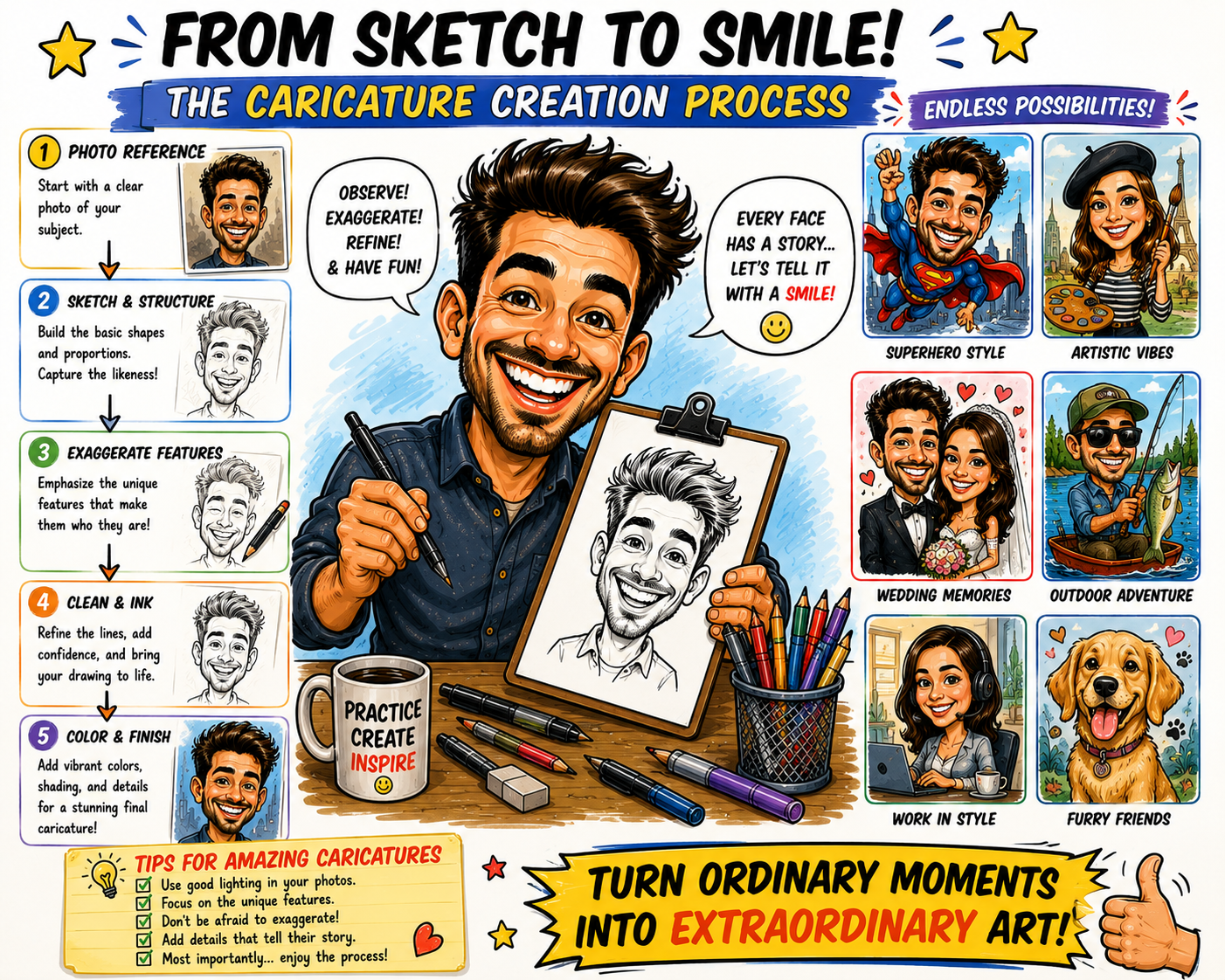
Drawing a caricature may look simple, but creating a funny portrait that still resembles the person requires careful observation and controlled exaggeration.
Beginners often focus on making facial features larger without first understanding the subject’s head shape, expression, proportions, and personality. The result may look like a cartoon, but not like the person in the reference photograph.
The good news is that most beginner caricature mistakes are easy to recognize and correct. This guide explains the most common problems and shows how to create stronger, more expressive portraits.
What Makes a Caricature Successful?
A successful caricature combines three important qualities: likeness, exaggeration, and personality.
The subject should be recognizable, the exaggeration should feel intentional, and the expression or pose should communicate something about the person.
15 Common Caricature Drawing Mistakes
1. Starting With Individual Features
Many beginners begin by drawing one eye, then the other eye, followed by the nose and mouth. This can create a collection of separate features that do not fit together.
The overall head shape should come first. Study the width of the forehead, fullness of the cheeks, jawline, chin, and hair shape before adding facial details.
Beginning with large shapes creates a stronger foundation and improves likeness.
2. Using the Same Oval Head for Everyone
Real heads come in many shapes. Some are round, square, long, narrow, triangular, heart-shaped, or pear-shaped.
Using the same standard oval for every subject removes one of the most recognizable parts of the face.
Before drawing, describe the head with one simple phrase, such as “wide forehead and narrow chin” or “round cheeks with a short jaw.”
3. Exaggerating Every Feature
Enlarging the eyes, nose, mouth, ears, chin, and hair at the same time creates visual confusion.
Strong caricatures usually emphasize only a few dominant features. The remaining features are reduced or simplified to create contrast.
Choose the two or three qualities that best define the person and allow those features to guide the design.
4. Exaggerating the Wrong Feature
The largest feature is not always the most important one. A person may have a noticeable nose, but their smile, eyebrows, hairstyle, or head shape may be more essential to recognition.
Spend time observing the whole face before deciding what to exaggerate.
Ask yourself which feature you would mention first when describing the person to someone else.
5. Ignoring the Space Between Features
Likeness depends partly on the distances between the eyes, nose, mouth, and chin.
A person may have close-set eyes, a long distance between the nose and mouth, or very little space beneath the lower lip.
You can enlarge individual features while preserving these relationships. Ignoring spacing often makes the caricature resemble someone else.
6. Copying the Photograph Too Literally
Some beginners become so focused on accuracy that they produce a realistic portrait instead of a caricature.
A caricature should simplify and reinterpret the subject. Look for patterns, contrasts, and unusual relationships rather than copying every visible detail.
Use the photograph as information, not as a set of lines that must be copied exactly.
7. Losing the Likeness Through Extreme Distortion
Exaggeration can be pushed too far. When important relationships are completely changed, the face may no longer be recognizable.
Increase exaggeration gradually. After each change, compare the drawing with the reference.
If the likeness becomes weaker, reduce the exaggeration or strengthen another identifying feature.
8. Giving Everyone the Same Smile
A generic cartoon smile removes personality. Some people smile broadly and show many teeth, while others smile mostly with their eyes.
Study the exact curve of the mouth, the position of the cheeks, visible dimples, and whether one side of the smile rises higher.
Capturing the subject’s natural expression can improve likeness more than adding realistic detail.
9. Making the Face Perfectly Symmetrical
Real faces are rarely symmetrical. One eyebrow may be higher, one eye slightly smaller, or one side of the mouth more expressive.
These differences can be essential to recognition and personality.
Do not automatically mirror facial features. Allow natural asymmetry to remain in the drawing.
10. Adding Details Too Early
Eyelashes, teeth, wrinkles, individual hairs, and clothing patterns can be tempting to draw, but they should not come before the basic structure.
If the head shape and facial placement are wrong, extra detail will not fix the drawing.
Work from large shapes to medium shapes and then add only the small details that improve recognition.
11. Drawing Every Strand of Hair
Hair is usually more effective when treated as one large shape with a few smaller sections.
Drawing every strand can make the image feel busy and distract from the face.
Focus on the overall silhouette, volume, hairline, part, curls, and direction of the hairstyle.
12. Using Weak or Scratchy Lines
Repeated uncertain lines can make a drawing look unfinished and difficult to read.
Use light lines during the planning stage, then create cleaner and more confident lines once the design is established.
Vary line thickness by using stronger lines around the outer silhouette and thinner lines around facial details.
13. Ignoring Body Language
A recognizable head placed on a stiff body can make the finished caricature feel lifeless.
Use pose and gesture to communicate whether the person is energetic, relaxed, confident, shy, playful, or serious.
A small cartoon body should support the personality shown in the face.
14. Overloading the Background
Props, hobbies, pets, and scenery can make a caricature more personal, but too many elements compete with the portrait.
Choose one clear setting and a small number of meaningful objects.
The face should remain the main focus of the composition.
15. Expecting the First Sketch to Be Perfect
Caricature drawing involves experimentation. Professional artists often create several quick versions before choosing the strongest idea.
One sketch may emphasize the eyes, another the head shape, and a third the smile or chin.
Comparing several rough drawings helps you discover which exaggeration best preserves the likeness.
Beginner Mistake vs. Better Approach
| Common Mistake | Better Approach |
|---|---|
| Drawing the eyes first | Establish the overall head and hair shape first |
| Making every feature larger | Choose only the most distinctive features |
| Using a generic smile | Study the subject’s natural expression |
| Adding detail immediately | Build the drawing from simple shapes |
| Making the face symmetrical | Preserve natural facial differences |
| Copying the photo exactly | Simplify and exaggerate with purpose |
| Using one finished sketch | Create several quick variations |
| Ignoring pose and accessories | Use body language and meaningful details |
How to Avoid Losing the Person’s Likeness
Likeness does not depend on realism alone. It comes from preserving the facial relationships that make the person unique.
Before adding detail, check the following:
- Is the head shape correct?
- Are the eyes spaced properly?
- Is the nose positioned correctly?
- Does the mouth have the right width and curve?
- Is the chin long, short, wide, or narrow?
- Does the hairstyle create the correct silhouette?
- Does the expression feel natural for the person?
If these larger relationships are correct, you can exaggerate more boldly without completely losing recognition.
Why Observation Matters More Than Drawing Speed
Beginners sometimes rush into drawing because they believe caricature should be fast. Speed is useful for live events, but it develops after observation and practice.
Before drawing, spend a few moments studying the person. Notice what appears large, small, high, low, wide, narrow, curved, or angular.
A short period of observation can save time by helping you choose the correct exaggeration from the beginning.
How to Simplify a Face
Simplification means reducing a complicated face into a few clear shapes.
The head may become a circle, rectangle, pear, triangle, or egg shape. The nose may become a curved wedge. Hair may become one large cloud-like shape.
Simple shapes are easier to adjust and exaggerate than detailed realistic features.
How to Choose the Right Level of Exaggeration
Not every caricature needs extreme distortion. The right level depends on the subject, audience, and purpose.
Subtle Caricature
A subtle style works well for wedding portraits, family gifts, business illustrations, and customers who prefer flattering artwork.
Moderate Caricature
Moderate exaggeration is useful for birthday gifts, social media portraits, event drawings, and humorous commissions.
Extreme Caricature
Strong exaggeration may suit comedy, editorial art, entertainment posters, or subjects who enjoy dramatic visual humor.
Begin with a mild exaggeration and increase it only while the person remains recognizable.
Traditional Drawing Mistakes
Traditional caricature artists must plan carefully because major changes can be difficult after the drawing is inked.
Common traditional drawing problems include:
- Pressing too hard during the first sketch
- Inking before the proportions are correct
- Using paper that does not match the chosen markers
- Smudging pencil or ink
- Adding color before checking the likeness
- Failing to test drawing tools before a live event
Begin with light construction lines and test all pens, markers, and colors on scrap paper.
Digital Caricature Mistakes
Digital tools make corrections easier, but they can introduce other problems.
Common digital mistakes include:
- Drawing on one layer only
- Using too many brush effects
- Zooming in and forgetting the overall composition
- Creating the artwork at a low resolution
- Flattening the file before revisions are complete
- Depending entirely on automatic filters
- Failing to save backup copies
Use separate layers for the sketch, clean lines, color, shading, and background. Save both an editable file and a finished export.
Why Automatic Filters Are Not Enough
Automatic filters can quickly create a cartoon effect, but they do not always understand which features are most important to a person’s identity.
A filter may enlarge the eyes or narrow the chin simply because those effects are part of its preset style.
An artist makes intentional choices based on the subject’s head shape, expression, personality, and distinctive features.
Filters can provide inspiration, but observation and artistic judgment create a more personal caricature.
How to Practice Caricature Drawing More Effectively
Draw the Same Face Three Times
Create one version focused on the head shape, one focused on facial features, and one that combines the strongest ideas.
Use a Timer
Try two-minute, five-minute, and ten-minute sketches. Short exercises help you focus on the most important information.
Write Observations Before Drawing
List five noticeable features before touching the pencil or stylus.
Compare With the Reference
Step back frequently and ask whether the drawing still looks like the subject.
Practice Different Ages and Face Shapes
Avoid drawing only one type of face. Practice children, adults, older people, different hairstyles, and a wide range of expressions.
A Simple Caricature Correction Checklist
Before finishing your artwork, ask:
- Does the head shape match the subject?
- Did I exaggerate the most distinctive feature?
- Are the facial features placed correctly?
- Does the expression feel natural?
- Is the person recognizable without the background?
- Did I simplify unnecessary details?
- Are the lines clean and confident?
- Does the pose support the personality?
- Is the face still the main focus?
- Have I checked the drawing from a distance?
How to Handle an Unsuccessful Caricature
Not every drawing will work, especially during the learning process. Instead of adding more detail, identify the largest structural problem.
Ask whether the head is too wide, the eyes are misplaced, the expression is wrong, or the exaggeration focuses on the wrong feature.
Sometimes starting a new quick sketch is more effective than repeatedly correcting a weak foundation.
Keep unsuccessful drawings so you can compare them with later work and see your progress.
Frequently Asked Questions
Why do my caricatures not look like the person?
The head shape, facial spacing, expression, or dominant features may be incorrect. Focus on the large relationships before adding detail.
What should a beginner exaggerate first?
Start with the feature or shape that appears most distinctive, such as the head shape, smile, nose, eyes, chin, cheeks, glasses, or hairstyle.
Should I draw realistic portraits before caricatures?
Realistic portrait practice can help, but it is not required. Beginners should understand basic facial structure, observation, proportion, and expression.
How much should I exaggerate?
Begin with a small change and gradually increase it while checking that the subject remains recognizable.
Is tracing a photo helpful?
Tracing can help study feature placement, but copying the photograph exactly will not teach exaggeration. Use the reference to understand the face, then redesign it with simple shapes.
Why do my caricatures look stiff?
The pose, expression, or line work may lack energy. Use curved gesture lines, natural asymmetry, and more expressive body language.
How often should I practice?
Frequent short sessions are effective. Even one or two quick face studies each day can improve observation, confidence, and drawing speed.
Final Thoughts
The biggest caricature drawing mistakes usually come from rushing, overcomplicating the face, or exaggerating without first understanding the subject.
Begin with the overall head shape, study the relationships between features, preserve the natural expression, and exaggerate selectively. Work from simple shapes toward smaller details.
Every unsuccessful sketch teaches you something about likeness, proportion, and design. With steady practice, your caricatures will become more recognizable, confident, and full of personality.
Caricature Related Articles
- 20 Caricature Artist Tips for Capturing Personality
- Best Digital Caricature Software for Funny Portraits
- Biggest Caricature Drawing Mistakes Beginners Make
- Caricature vs. Cartoon: What’s the Difference?
- Fun Caricature Ideas for Families, Weddings and Gifts
- History of Caricature Art: From Early Sketches to Digital Portraits
- How AI Is Changing Caricature Art and Digital Portraits
- How to Draw a Caricature: Beginner Step-by-Step Guide
- How to Make Money Drawing Caricatures Online and at Events
- How to Turn a Photo Into a Caricature and Keep the Likeness