
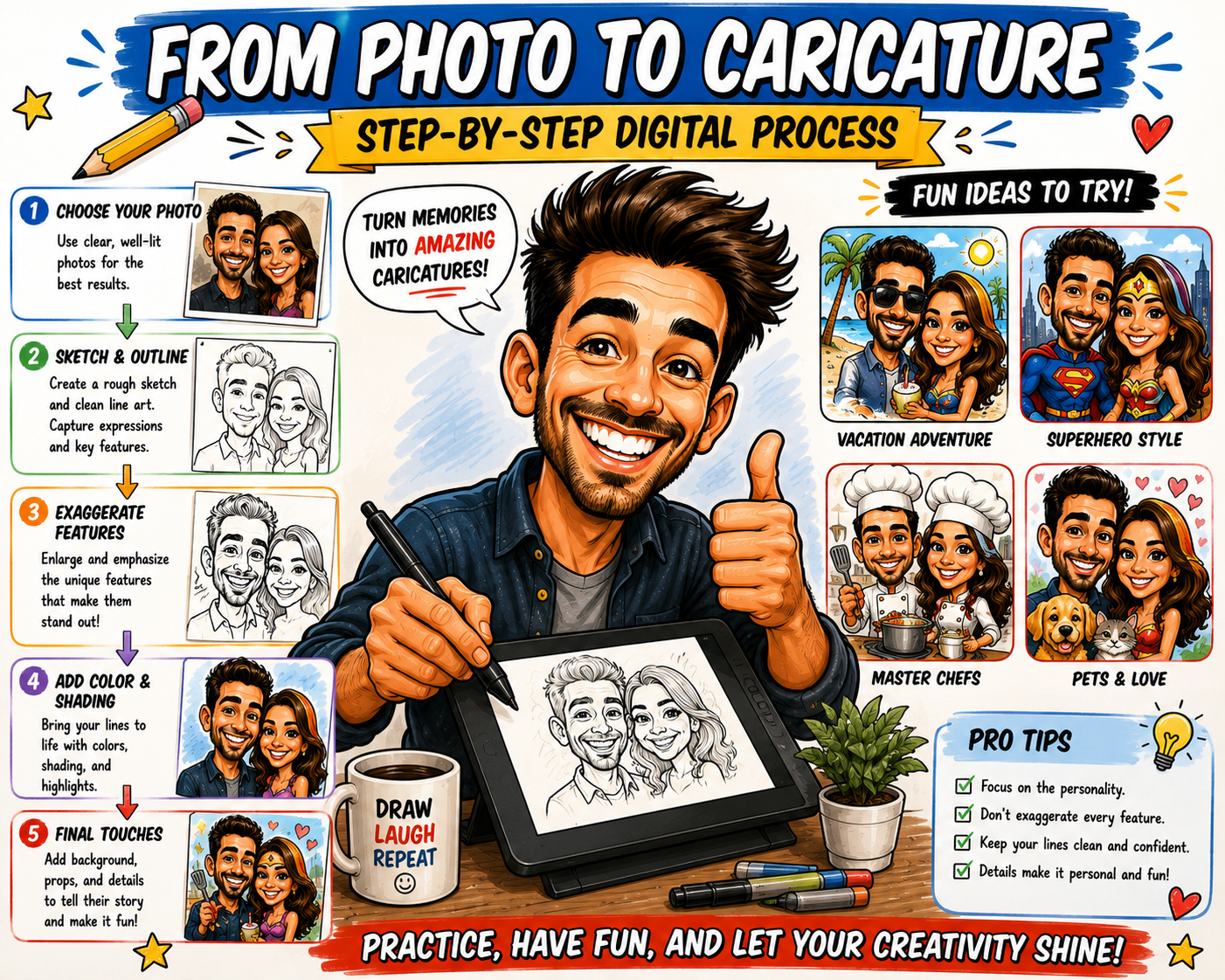
Caricature art has entertained, amused, criticized, and celebrated people for centuries. By exaggerating a person’s most recognizable features, caricature artists can create portraits that feel humorous, expressive, and instantly memorable.
The history of caricature stretches from early experiments in portrait drawing to political satire, newspaper illustration, live event entertainment, personalized gifts, and modern digital artwork.
Although the tools have changed, the central goal remains the same: capture the subject’s likeness and personality through creative exaggeration.
What Is Caricature Art?
A caricature is an exaggerated portrait of a real person. The artist may enlarge the eyes, widen the smile, lengthen the chin, shrink the body, or emphasize a distinctive hairstyle.
Unlike a completely fictional cartoon character, a caricature depends on recognition. The subject should still be identifiable even when the proportions are dramatically changed.
Where Did the Word Caricature Come From?
The word caricature developed from an Italian term associated with loading, emphasizing, or exaggerating. In visual art, it came to describe portraits in which an artist intentionally increased the importance of certain features.
The idea is similar to adding extra visual weight to a face. A prominent nose becomes longer, rounded cheeks become fuller, or an expressive smile becomes much wider.
This exaggerated approach allowed artists to explore personality and humor in ways that formal portrait painting often did not.
Early Experiments With Exaggerated Faces
Artists have long studied unusual faces, expressions, and proportions. Early sketchbooks often contained quick observations of people with distinctive features.
These studies were not always intended as finished caricatures. Some were exercises in anatomy, emotion, character, or facial variety.
Over time, artists discovered that exaggeration could create recognizable portraits while also expressing humor, criticism, affection, or social observation.
Caricature During the Renaissance
During the Renaissance, European artists became increasingly interested in anatomy, portraiture, facial expression, and human individuality.
Alongside formal portraits, artists created informal sketches that explored unusual profiles, dramatic expressions, and exaggerated features. These experimental drawings helped establish many of the visual ideas later associated with caricature.
The ability to capture a recognizable face with only a few lines became an important artistic skill. Exaggeration showed that a portrait did not need perfect realism to communicate identity.
The Growth of Social and Political Satire
Caricature became especially powerful when artists began using exaggerated portraits to comment on public life.
Political leaders, wealthy citizens, celebrities, and other public figures could be portrayed with oversized features, symbolic clothing, unusual poses, or humorous surroundings.
These images allowed artists to communicate complicated opinions quickly. Even viewers who did not read long articles could understand the basic message of a strong visual satire.
A large crown might suggest excessive power. An oversized money bag could represent greed. A tiny body beneath a large head might make an important person appear foolish or self-important.
Printing Helped Caricature Reach Larger Audiences
As printing methods improved, caricatures could be reproduced and distributed to more people.
Instead of remaining private sketches or individual artworks, exaggerated portraits appeared in printed sheets, pamphlets, magazines, newspapers, and books.
This wider circulation helped caricature become an important part of popular culture. Artists could respond to public events, personalities, scandals, fashions, and changing social attitudes.
Caricature in Newspapers and Magazines
Newspapers and magazines gave caricature artists a regular platform. Editorial illustrations could combine exaggerated portraits, symbols, captions, and visual jokes.
A single drawing could summarize a public controversy or show a well-known personality in a memorable way.
Caricatures also appeared in entertainment publications, theater programs, society pages, sports coverage, and celebrity features.
These printed portraits helped shape how audiences remembered public figures.
Caricature as Entertainment
Caricature was not limited to criticism or politics. Artists also discovered that people enjoyed seeing humorous versions of themselves.
Quick portrait drawing became popular at fairs, festivals, amusement areas, restaurants, tourist attractions, and special events.
The live drawing process became part of the entertainment. Guests could watch an artist transform ordinary facial features into a playful portrait within minutes.
Live caricatures also created an affordable souvenir that was both personal and easy to take home.
The Classic Oversized Head and Small Body
One of the most familiar caricature styles combines an oversized head with a much smaller cartoon body.
The large head keeps attention on the face, while the small body adds humor and allows the artist to include a profession, hobby, costume, or activity.
A musician might be shown with a tiny guitar-playing body. A golfer may swing an oversized club. A chef might stand beside an enormous cake.
This format remains popular because it combines likeness, personality, storytelling, and comedy in one image.
Caricature and Celebrity Culture
As theater, film, television, sports, and popular entertainment expanded, caricature artists found an endless supply of recognizable subjects.
Performers and public personalities often have distinctive hairstyles, expressions, costumes, voices, or body language. These qualities make them ideal for caricature.
Celebrity caricatures appeared in magazines, posters, advertisements, restaurant displays, promotional materials, and entertainment venues.
A successful celebrity caricature could communicate the subject’s identity with only a few exaggerated lines.
Caricature in Animation and Character Design
Caricature principles also influenced animation and cartoon character design.
Animators learned that exaggerated shapes could communicate personality quickly. A wide chest and square jaw might suggest strength, while a long narrow body could suggest nervousness or elegance.
Exaggerated expressions helped animated characters communicate emotion clearly, especially when movement was fast.
Although fictional cartoon characters are not always caricatures, both art forms use simplification, contrast, and exaggeration to create memorable designs.
From Pen and Ink to Color Illustration
Early caricatures were often created with pencil, charcoal, ink, engraving, or other monochrome techniques.
As reproduction and printing methods improved, artists gained more opportunities to use color. Bright clothing, expressive backgrounds, and decorative details made caricatures more attractive for gifts, advertisements, posters, and entertainment.
Color also helped artists separate facial features, emphasize expressions, and create a stronger mood.
The Rise of Personalized Caricature Gifts
Personalized caricatures became popular for birthdays, weddings, anniversaries, graduations, retirements, and workplace celebrations.
Instead of drawing only a face, artists began creating complete scenes that included hobbies, pets, careers, vehicles, favorite places, and meaningful objects.
A wedding caricature might show a smiling couple in formal clothing. A retirement portrait could place the subject on a beach, golf course, fishing boat, or garden.
This combination of likeness and personal storytelling turned caricature into a memorable keepsake.
The Development of Digital Caricature Art
Computers, drawing tablets, touchscreen devices, and illustration software changed how caricatures could be created and delivered.
Digital artists gained the ability to draw on layers, move facial features, resize the head, test colors, correct mistakes, and create different versions of the same portrait.
Digital artwork could also be delivered electronically, shared on social media, printed on merchandise, or used as a profile picture.
These tools made custom caricature services available to customers far beyond the artist’s local area.
Traditional and Digital Caricature Compared
| Feature | Traditional Caricature | Digital Caricature |
|---|---|---|
| Common tools | Pencil, ink, markers, paint, and paper | Tablet, stylus, computer, and drawing software |
| Corrections | May require erasing or redrawing | Can often be undone, moved, resized, or edited |
| Original artwork | A physical drawing exists | The original is usually a digital file |
| Delivery | Handed to the customer or shipped | Can be sent electronically |
| Reproduction | Requires scanning or photography | Can be exported for printing and online use |
| Best known for | Original line quality and live drawing | Flexible editing, color, and multiple formats |
Online Caricature Commissions
The internet made it possible for customers to order personalized caricatures by submitting photographs and project details online.
Artists can now create portraits for customers in different cities or countries. The finished artwork may be delivered as a downloadable file or printed on canvas, clothing, mugs, cards, posters, and other products.
Online commissions also allow customers to request specific clothing, settings, hobbies, pets, and text.
Caricature in the Social Media Era
Social media gave caricature artists new ways to display their work, connect with customers, and share drawing videos.
Fast time-lapse recordings let viewers watch a face transform from a simple sketch into a finished digital portrait.
Caricatures are also used as profile images, reaction graphics, promotional posts, humorous gifts, and online avatars.
The visual and shareable nature of caricature makes it well suited to online platforms.
Automatic Filters and AI-Assisted Caricatures
Modern applications can apply cartoon filters, reshape facial features, change artistic styles, and generate portrait variations.
These tools can be useful for entertainment, experimentation, and creative inspiration. However, automatic results may not understand which features are most important to a person’s identity.
A skilled caricature artist makes deliberate decisions about likeness, personality, humor, and composition. Technology can assist the process, but artistic observation remains essential.
A Simple Timeline of Caricature Art
- Early Face Studies Artists explored unusual expressions, profiles, anatomy, and facial variety through informal sketches.
- Renaissance Experimentation Greater interest in portraiture and human individuality encouraged artists to study exaggerated faces and expressive features.
- Political and Social Satire Caricature became a way to criticize leaders, institutions, fashions, and public behavior.
- Expansion Through Printing Printed images allowed caricatures to circulate through pamphlets, newspapers, magazines, and books.
- Live Entertainment Quick caricature drawing became popular at fairs, festivals, tourist attractions, parties, and special events.
- Personalized Gift Art Artists created custom portraits for weddings, birthdays, anniversaries, graduations, and retirement celebrations.
- Digital Drawing Tablets and software made it easier to revise, color, reproduce, and deliver caricature artwork.
- Online and AI-Assisted Art Caricatures became widely available through online commissions, mobile apps, social media, and automated creative tools.
Why Caricature Has Lasted So Long
Caricature remains popular because people enjoy seeing familiar faces transformed into something surprising.
It can make powerful people seem ordinary, celebrate a loved one’s personality, entertain guests at an event, or turn a photograph into a unique gift.
Caricature is flexible enough to be political, affectionate, elegant, humorous, critical, or playful.
Few art forms can communicate likeness, personality, and humor so quickly.
How Caricature Styles Have Changed
Caricature styles have evolved with changes in culture, technology, printing, and entertainment.
Some artists prefer loose pencil lines and spontaneous expressions. Others create polished paintings with realistic lighting and exaggerated anatomy.
Modern digital caricatures may use bold vector shapes, soft painted textures, comic-book outlines, three-dimensional effects, or animation.
Despite these differences, strong caricatures continue to depend on careful observation and meaningful exaggeration.
What Modern Artists Can Learn From Caricature History
The history of caricature shows that technical realism is not the only way to capture a person.
Artists can create a strong likeness by studying head shape, facial spacing, expression, silhouette, and personality.
Modern artists can also learn the importance of simplicity. Historic caricatures often used only a few powerful lines, yet the subject remained recognizable.
New technology provides more tools, but observation and artistic judgment remain the foundation of successful caricature art.
Frequently Asked Questions
What is caricature art?
Caricature art is an exaggerated form of portraiture that emphasizes the most recognizable features, expressions, and personality traits of a real person.
Why did caricatures become popular?
Caricatures became popular because they could communicate humor, criticism, personality, and social commentary through clear and memorable images.
Are caricatures always political?
No. Caricatures are also created for entertainment, gifts, weddings, birthdays, family portraits, festivals, advertising, and business promotion.
When did digital caricatures become popular?
Digital caricatures grew as computers, drawing tablets, illustration software, touchscreen devices, online commissions, and social media became more widely available.
What is the difference between a caricature and a portrait?
A traditional portrait usually aims for realistic proportions, while a caricature intentionally exaggerates selected features while preserving the subject’s likeness.
Can a caricature be flattering?
Yes. A caricature can emphasize a cheerful smile, stylish clothing, favorite activities, and positive personality traits while keeping the exaggeration friendly.
Is digital caricature still considered real art?
Yes. Digital caricature requires observation, drawing skill, composition, color choices, exaggeration, and creative judgment, just like traditional artwork.
Final Thoughts
The history of caricature art is a story of changing tools and lasting human curiosity. From early sketches and printed satire to live event drawings and digital portraits, artists have continually found new ways to exaggerate recognizable faces.
Caricature has survived because it can do many things at once. It can make people laugh, communicate criticism, preserve a memory, celebrate a personality, and create a highly personal gift.
Whether created with ink, markers, a drawing tablet, or modern software, the best caricatures still begin with the same essential skill: carefully observing what makes a person unique.
Caricature Related Articles
- 20 Caricature Artist Tips for Capturing Personality
- Best Digital Caricature Software for Funny Portraits
- Biggest Caricature Drawing Mistakes Beginners Make
- Caricature vs. Cartoon: What’s the Difference?
- Fun Caricature Ideas for Families, Weddings and Gifts
- History of Caricature Art: From Early Sketches to Digital Portraits
- How AI Is Changing Caricature Art and Digital Portraits
- How to Draw a Caricature: Beginner Step-by-Step Guide
- How to Make Money Drawing Caricatures Online and at Events
- How to Turn a Photo Into a Caricature and Keep the Likeness